Journey of a Rape Kit
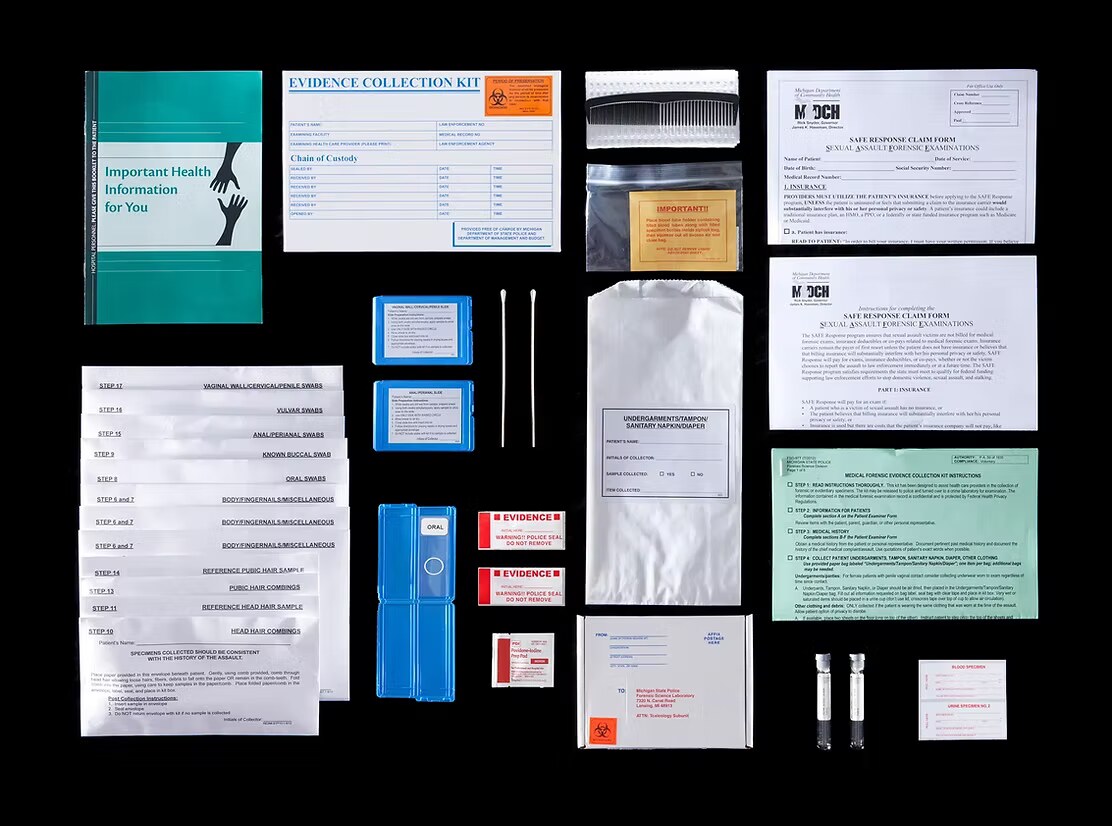
You may have heard about the rape kit backlog – it refers to the backlog of unanalyzed rape kits that stand idle in police departments and crime lab storage facilities across America. It is estimated that hundreds of thousands of kits remain unopened and untested in the backlog today. This means that precious DNA evidence from a sex crime never enters the criminal justice system, limiting survivors’ access to justice. This is particularly egregious given that perpetrators of these crimes are likely to have a criminal history and attack multiple victims over their lifetime. The identification and prosecution of a single perpetrator can potentially prevent multiple assaults.
Critical statistics on sexual assault:
- Every 68 seconds, someone is sexually assaulted in the United States
- 8 out of 10 rapes are committed by someone known to the victim
- Only 25 out of every 1,000 rapists will end up in prison
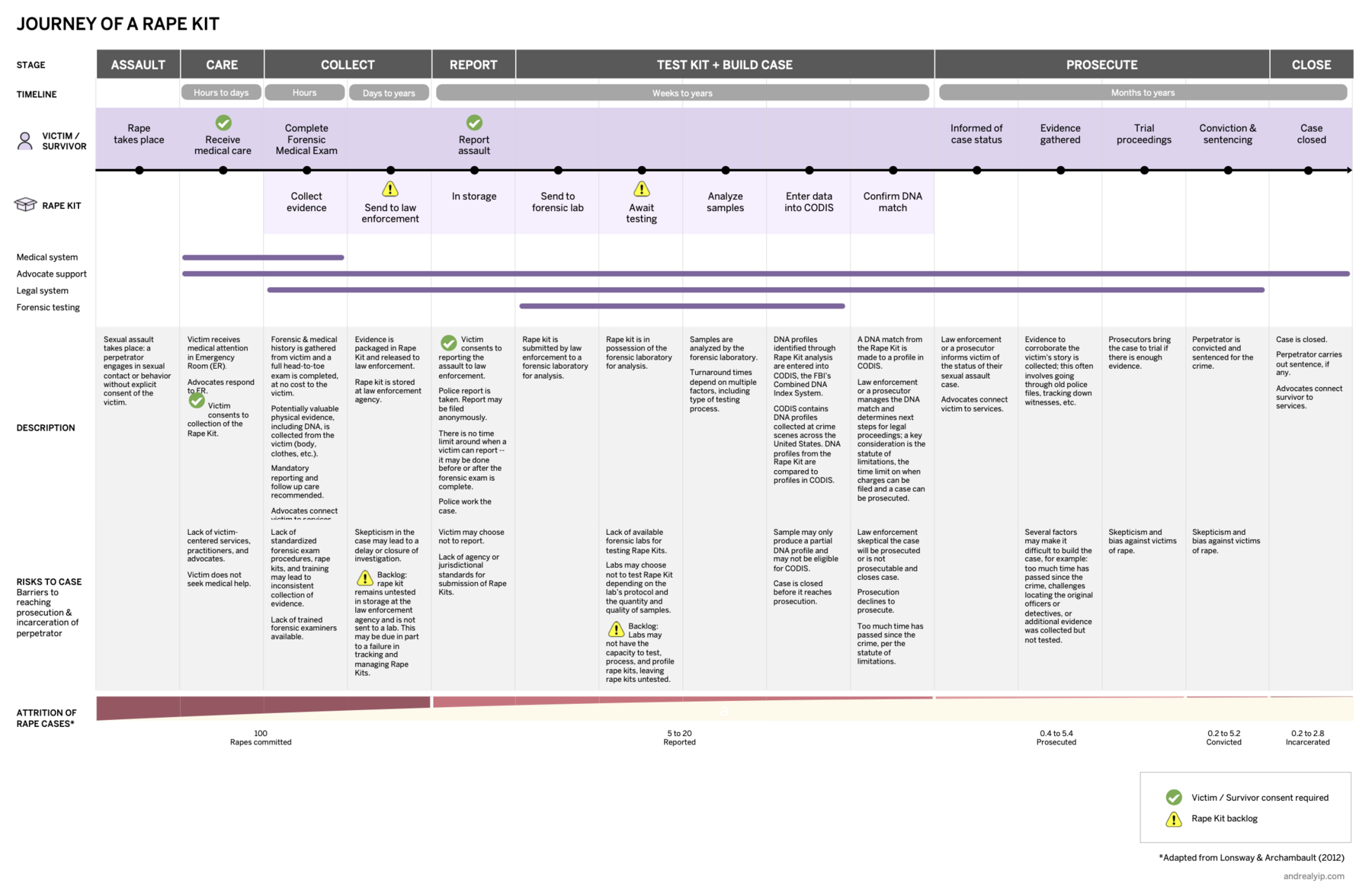
The purpose of this post is to understand and visualize the journey of a rape kit and identify where in this journey kits are backlogged. We couch this journey in that of a survivor as they navigate the criminal justice system: from the assault, to the process of gathering DNA evidence, to the prosecution of a perpetrator, and closure of the case.
What Is a Rape Kit?
A rape kit plays a central role in a sexual assault criminal investigation. When a victim is sexually assaulted, their body becomes a part of the crime scene. Should they choose to report the assault to law enforcement, a victim may undergo a sexual assault forensic exam. It is during this extensive 4-to-6-hour exam that a sexual assault forensic examiner will collect DNA evidence from the victim’s body and preserve it in a rape kit.
Upon completion of the exam, the kit is sent to a forensic crime lab for analysis. DNA profiles from the evidence are identified and entered into CODIS, the FBI’s Combined DNA Index System, where it is compared to DNA profiles of perpetrators collected from crime scenes across the US. If there is a match, the evidence is used by prosecutors to bring a legal case to trial. From there, a perpetrator may be convicted and sentenced for their crimes.
Victim advocates play a key role throughout the journey by providing support directly to the victim. They are trained to offer emotional support, point victims to relevant resources and services, and more.
A National Crisis
According to RAINN, there are two primary drivers of the rape kit backlog:
- Rape kits are never sent to a crime lab: This happens when law enforcement and/or prosecutors do not request DNA analysis of the kits. Kits remain untested or un-submitted and wait indefinitely in storage at a law enforcement facility, hospital, or rape crisis center.
- Rape kits are sent to a crime lab but are not tested: This happens when crime labs lack the resources to keep up with the demand to test, process, and profile samples from kits. Kits remain untested at the crime lab indefinitely.
A failure to count and track kits makes it difficult to monitor them as they move through the chain of custody. The number of untested kits across the US remains an estimate.
Seeking Justice
Perpetrators of sex crimes are rarely brought to justice. A study by Lonsway and Archambault (2012) provides a startling view into the attrition of rape cases as they progress through the criminal justice system: of every 100 rapes committed, only 0.2 to 2.8 perpetrators are incarcerated for their crimes.
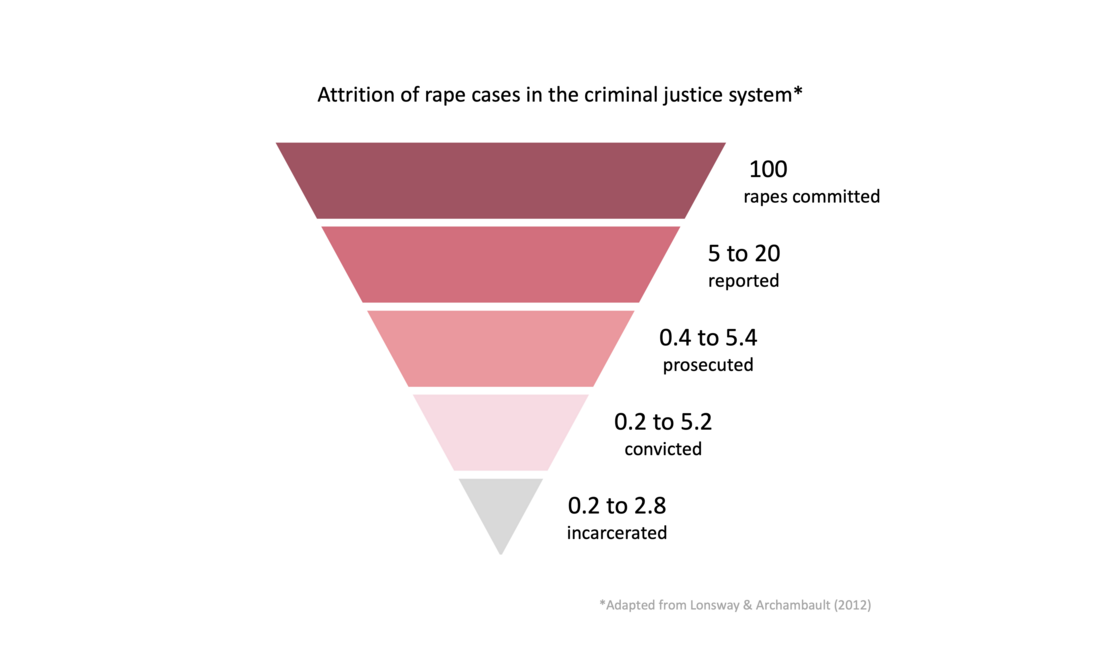
Sex crimes are notoriously difficult to prosecute for myriad reasons: two in three sexual assaults are not reported. Victims choose not to report out of fear of retaliation, because they are ashamed, because they believe it’s their fault, or because they don’t think anyone will help them. Sex crimes are approached with skepticism, with victims bearing the brunt of the blame and judgement for the violence they have experienced. We examine this further in my previous post on the journey of a sexual assault survivor.
Underlying many of these barriers are deeply rooted social and cultural beliefs that sexualize and dehumanize victims. Legal and political systems in particular disempower female survivors. Case in point: the Supreme Court’s recent decision to overturn Roe vs Wade is actively stripping women of their right to bodily autonomy and control over their own reproductive and economic futures.
Creating the Journey
The journey of the rape kit is couched in that of the victim/survivor. A few points about the journey map:
- There are key “systems” that overlay the journey:
- Medical system: when the survivor engages in medical care, including the forensic medical exam.
- Advocate support: when the survivor interacts with victim advocates.
- Legal system: when the criminal justice system, including police and prosecutors, get involved in working the case and bringing it to trial.
- Forensic testing: when DNA evidence is collected and analyzed.
- “Risks to case” describe blockers that may prevent a case from advancing through the stages of the journey.
- “Attrition of rape cases” uses data from Lonsway and Archambault (2012) to demonstrate how few rape cases actually lead to a conviction of the perpetrator.
Assumptions
- The legal definition and management of sexual assault crimes varies by jurisdiction. For our purposes, we take a generalized, “national” view into the journey of a rape kit.
- The journey follows the expected steps that a survivor experiences as they advance through the criminal justice system, from assault to the process of gathering DNA evidence to the prosecution of a perpetrator and closure of the case. In practice, the journey is complex, non-linear, and governed by various state and federal laws. It’s likely that certain steps may not be experienced in the order shown here. For example, a victim may report the crime later on in the journey, after the kit testing is complete.
- The journey is idealistic — rarely is a perpetrator prosecuted and convicted of their crimes. There are many points at which the journey can end prematurely, and the rape kit backlog only makes this more likely to happen.
- The journey is a learning tool. This work is not intended to offer any legal advice or guidance.
- At the end of this post, I’ve defined terms that I use throughout this work.
Learn About the Backlog
I was motivated to create this journey after reading about the admirable leadership of Prosecutor Kym Worthy in addressing the rape kit backlog. To create this journey, I spoke to several sexual assault experts who graciously offered me their insight and feedback on this issue. If you’re interested in learning more about the rape kit backlog, I encourage you to check out RAINN.org, EndtheBacklog.org, and SAFEta.org for national best practices and protocols for Sexual Assault Forensic Examinations.
With Gratitude
Thank you to the sexual assault researchers, healthcare workers, and law enforcement professionals who provided me with advice and feedback on this journey map. I’m grateful for your dedication and tireless efforts to design systems that prevent sexual violence and empower survivors.
✦ ✦ ✦
A Note About Language
I’ve used specific terms throughout this post which I clarify below:
- Forensic medical exam
- The head-to-toe exam that is performed by a trained practitioner in accordance with a rape kit to gather potential DNA evidence from a patient who has been sexually assaulted.
- Perpetrator
- A person who commits a sexual assault.
- Rape
- A form of sexual assault that includes sexual penetration without consent.
- Rape kit
- The package of items that is used by medical professionals for the collection and preservation of forensic evidence following an allegation of sexual assault. A rape kit is also known as a sexual assault kit or sexual assault evidence kit.
- Sexual assault
- Sexual contact or behavior that occurs without explicit consent of the victim, including rape, attempted rape, unwanted sexual touching or fondling, and forcing a victim to perform sexual acts.
- Sexual assault forensic examiner (SAFE)
- A specially trained healthcare professional (e.g., nurse practitioner, physician, nurse) who performs the sexual assault forensic medical exam. A SAFE may be interchangeably referred to as a SART (sexual assault response team) or SANE (sexual assault nurse examiner).
- Victim / Survivor / Patient / Client
- A person who has been sexually assaulted is identified by different terms depending on the professional discipline involved (“victim” in the criminal justice system, “patient” when engaged with medical professionals, and “survivor” or “client” by advocates or rape crisis centers). For simplicity, I use victim and survivor interchangeably.